
Stop the Guesswork: A Practical Guide to Choosing Between CNC Machining, Die Casting, and Sheet Metal
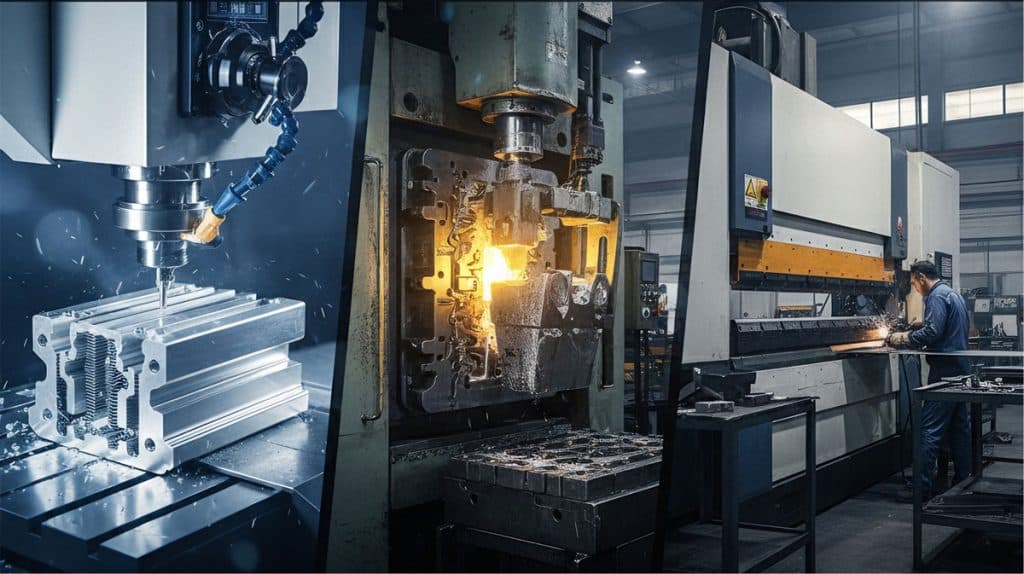
On drawings, the choice between CNC machining, die casting, and sheet metal fabrication often appears straightforward. Yet in real-world production, OEMs frequently make suboptimal process decisions—driving up costs, extending lead times, and creating downstream assembly challenges. The real difficulty lies not in understanding what each process is, but in how each behaves under actual manufacturing constraints such as tolerance requirements, supply-chain limitations, and volume fluctuations.
This article provides a technical comparison of these processes, highlights common engineering pitfalls, and explains how engineering-driven suppliers help OEMs avoid unnecessary risks and costs.
1. CNC Machining: Precision and Flexibility, but Highly Sensitive to Unit Cost
CNC machining is often seen as the safest choice due to its precision and repeatability, with tolerances commonly guided by standards such as ASME Y14.5. However, for complex geometries, CNC becomes the most cost-sensitive option due to material waste and long machining cycles.
When CNC is Suitable
- Low to medium volumes or complex geometries with tight yield requirements.
- High-precision components in medical, aerospace, or instrumentation applications.
- Prototyping and engineering validation (EVT/PVT).
- Structures unsuitable for casting or forming.
- Components requiring high thermal conductivity, such as heatsinks.
Common OEM Mistakes
- Keeping CNC at volumes suitable for die casting.
- Skipping DFM optimization that could reduce machining time.
- Specifying unnecessarily tight tolerances.
Industry Example
A consumer electronics enclosure was initially machined during prototype runs. Once volume increased to several thousand units, the per-piece CNC cost surged. After evaluating alternative processes with a multi-process supplier, the team shifted to die casting with selective CNC post-machining, reducing total cost by around 30%.
2. Die Casting: Ideal for Scale, but Requires Planning and Realistic Expectations
Die casting delivers strong cost efficiency at higher volumes, but the fixed tooling cost and lengthy lead time are commonly underestimated during early planning. The process is typically used for aluminum, zinc, or magnesium alloys, and the material itself limits applicability. Manufacturers often reference guidelines from industry bodies such as NADCA to ensure quality and dimensional stability.
When Die Casting Is Suitable
- Medium to high-volume production where tooling cost can be amortized.
- Components requiring stable geometry and consistent repeatability.
- Complex 3D structures that are costly to machine.
- Applications where minor cosmetic imperfections are acceptable.
Common OEM Mistakes
- Misjudging economic order quantity and using die casting for low-volume builds.
- Underestimating tooling lead time (often 12–20+ weeks).
- Expecting CNC-level precision without secondary machining.
Industry Example
An industrial equipment manufacturer initially machined a complex aluminum housing. Once annual volume projections increased, die casting became significantly more economical. After switching, total unit cost—including secondary machining—decreased by nearly half, and dimensional consistency improved across batches.
3. Sheet Metal: Highly Flexible, but the Most Frequently Misapplied
Sheet metal is well-suited for structural parts, enclosures, and brackets. Its key advantages are low tooling cost, high design flexibility, and strong suitability for large parts or multiple variant SKUs. Processes within sheet metal fabrication are often guided by standards defined by organizations such as the Fabricators & Manufacturers Association (FMA).
When Sheet Metal Is Suitable
- Medium-complexity, medium-to-high-volume parts.
- Large structures unsuitable for casting.
- Cost-sensitive housings or structural components.
- Parts requiring bending, welding, assembly, and surface finishing.
- Designs requiring fast iteration with minimal tooling cost.
Common OEM Mistakes
- Over-engineering bends or radii, increasing scrap and fabrication cost.
- Mixing casting-like features into sheet metal designs (such as dense bosses).
- Choosing improper material thickness or grades that lead to vibration or fatigue issues.
Industry Example
A networking equipment enclosure was originally designed with several small internal features more suitable for casting. After redesigning the part for true sheet-metal manufacturability, the team reduced fabrication steps, simplified welding operations, and cut total cost by roughly 25%, while improving assembly consistency.
4. Why Misjudgment Happens So Frequently
Across the industry, four recurring issues cause process misalignment:
- Compressed development timelines without DFM review
- Supplier capabilities limited to a single process
- Lack of early manufacturing feedback to engineering
- Comparing unit price only and ignoring total lifecycle cost
5. The Value of an Engineering-Integrated Supplier
A supplier with multi-process capabilities and strong DFM expertise enables OEMs to:
- Conduct structured cost and tolerance comparison across processes
- Choose the optimal process for each stage (EVT → PVT → MP)
- Identify risks early and compress development timelines
- Maintain flexibility instead of being locked into a single process
Conclusion
Choosing the right manufacturing process is a strategic engineering decision—not a simple pricing exercise. OEMs that integrate early-stage DFM insights and multi-process evaluation can significantly reduce risk, improve cost structure, and accelerate time-to-market.
If you have ever struggled with choosing the right process, balancing cost versus precision, or managing the transition from prototype to volume, feel free to reach out. Our engineering team can help explore the options and share practical guidance based on multi-process experience.
Disclaimer: The scenarios and examples described in this article are generalized industry situations created for illustration purposes and do not reference any specific customer or project.